
You must log in or # to comment.
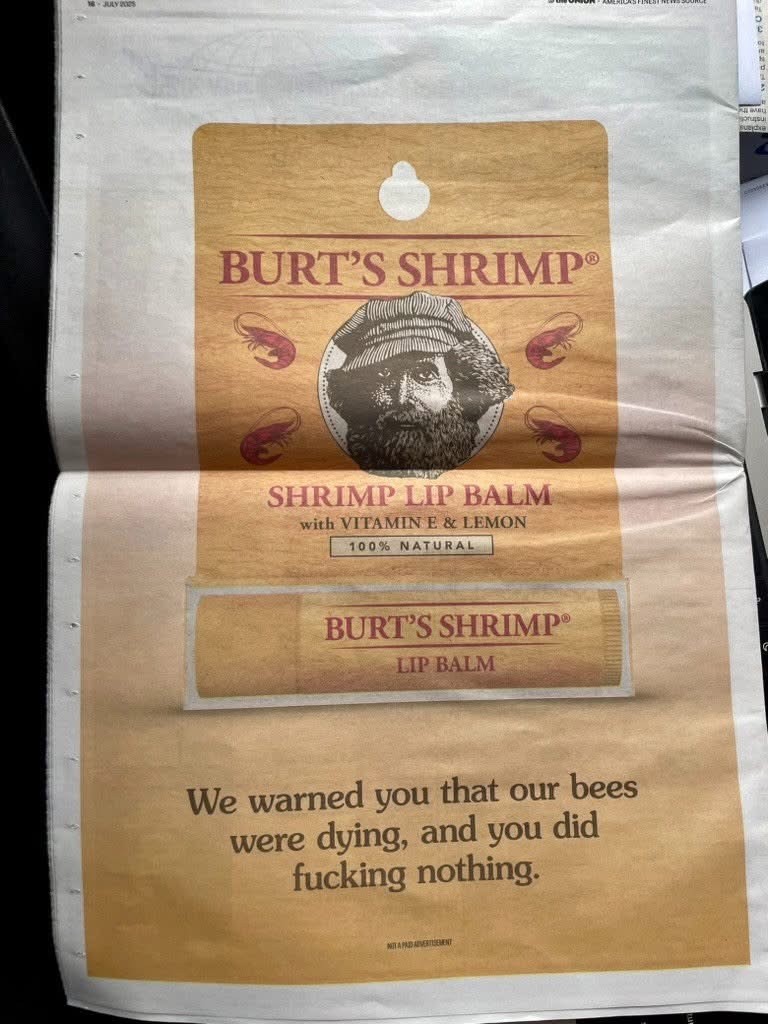
you did nothing
Bitch, I haven’t killed a single bee since this conversation started. Stop blaming me for the dead bees. I’ve gone out of my way to be nice to bees.
I killed one bee extra per bee to offset your commitment.
That’s an interesting statement from a company that’s owned by Clorox
I mean… We still don’t know why the honey bee is dying (yes, specifically the honey bee. Other bees seem to be doing OK).
Yes, it could be the industry, or it could be climate change, or it could be the use of pesticides… But while it could be all of those things, none of those things fit entirely.
So even if a whole lot of people are willing to do something to prevent the honey bee population from going poof… We wouldn’t know what to do exactly.
Wait, this is not true. At least not in Europe, look it up. Honey bees are not dying, on the contrary. There are too many of them and biodiversity drops around their hives. Save the bees has never been about the honey bee.
The conflation of Apis Mellifera with the native species that we actually need is one of my biggest pet peeves.
My understanding is that honey bees are dying in farmed environments in the USA. Basically farmers will pay these large bee hive companies to bring bees in tractor trailers to their farm and let them out for a period of time to help pollutant their fields. These bees are the ones having record die offs, but from what I understand the die offs are less than the number of new bees being made.
Basically the efficiency of the corporate farming operation is decreasing, but the captive bee population is fine.
If someone out there knows better and has source information I would love to be corrected.
Interesting. So the honey industry might not even be as under threat as it lets on.
*those in power did fucking nothing
While true, “we did fucking nothing” is also entirely true. The vast majority of humans don’t give a shit about the environment. No matter their wealth and power. It’s only a lot more noticable and harmful when Jeff Bezos flies to space. But let’s be real here. If average Joe White (43) had the means to fly to space, he would do so without a second thought of the environment!
We’re dealing with a pandemic of selfish assholes and one of its symptoms are selfish billionaires who destroy in seconds what a few thousand conservationists achieved in a year!
It’s a systemic issue, so pointing fingers at any one entity is not going to be helpful.
Go to any garden center. What proportion of plants sold are actually native and beneficial to the area? Let’s say you want a grass lawn. What does the path of least resistance to getting that look like? What species are planted? What chemicals are used? What are the dominant practices around that?
These questions don’t even touch commercial agriculture, which comes with issues on a much larger scale, but it’s out of sight for most.
If we are to change our ways for the better it’s going to have to be a complete realignment in all areas from top to bottom.
If enough individual people who own land with yards grew native plants and flowering bushes and stopped using so much pesticide outside, it would make a huge difference.
who own land
Let me stop you right there…
…And on the slim chance you got past that hurdle…
[HOA has entered the chat]
It would do wonders but not for this issue. The only bees that are dying are industrially farmed bees. Making it somehow your fault is another amazing trick by thr corpos to shift the blame for what they do on people who has nothing to do with it.
Stop doing lawns is a good idea though, regardlessMaking it somehow your fault is another amazing trick by thr corpos to shift the blame for what they do on people who has nothing to do with it.
If you have a better plan that individual people can do who don’t want to fight corporations, be sure to put in the same effort to spread those ideas as well.
If you have a better plan that individual people can do who don’t want to fight corporations
Yes. The plan is very simple - stop not wanting to fight corporations (in a broad sense, sometimes it’s not just corporations, I’m oversimplifying here).
No individual effort can be meaningful as long as there are corpos with the desire to see the line go up on the other side. You can’t “vote with your dollar” if the choices you presented with are controlled by profit seeking, you can’t “do your small part” if you don’t have neither means nor understanding of what even needs to be done. If you don’t buy high fructose corn sirup, it will be bought with your money without your input in the matter. That sort of thing.
The unfortunate and very unfair thing is that individual can do things worse for themselves and for the community they’re part of, this power we have and nobody is taking it from us. But a person can’t fix what’s broken by the uncaring leviathan of profit seeking, that can only be fixed collectively.
We’re also losing native species. Both bees and wasps.
Not in more significant numbers that any other life around, and for entirely understood reasons.
You’re telling me a shrimp lipped that balm?

It’s balm made from shrimp lips.
Shrimp flavoured or shrimp scented?
Shrimp textured.
My lips feel shrimp-textured
Made of shrimp but smells of anaphylaxis
Yes
First one, then the other.
Thanks for the laugh
If this were a real product, I would guess it’d be using the shrimp shells to make gelatin or something out of. In that case, neither, unless they added flavor/scent.
Honestly though, I think I could enjoy and Old Bay scented and flavored lip balm.
Shrimp balmed lip
makes my mouth swell up just like the real thing! Boy do I love food allergies
Makes it way easier to convince cats to kiss me
Honey bees aren’t at risk of extinction
Ain’t nobody going to educate the millions of people who don’t give two shits about facts and science about the vast diversity of bee species and other flying insects.
If people start doing more to help “honey bees” broadly like growing wild flowering plants and reducing pesticide use, it will also help the other native species.
Let me put it another way, we need to BE VERY CAREFUL about trying to over-lecture about this kind of situation. We’re in a climate where trying to teach people knowledge isn’t received as a gift or benefit. Teachers are tuning their lessons for 7-minute attention spans and high emotional sensitivity, we all need to do the same.
But the other bees and pollinators are. And thats scary.
The distinction is key. Honeybees are one of the biggest reason other Bees and native pollinators are going extinct. Honey bees are voracious foragers and will out compete almost all other pollinators.
There are anti honey bee non profits with missions between eradicating honey bee nests they find to just relocating them to places where they can be used for monocrops.
If the extreme native pollinator crowd got their way we would all be fucked as honey bees currently account for 75% of ag pollination, with the remainder mostly being self pollinated plants.
Sometimes jokes where the punchline are based around absurdity will simplify or ignore the nuance of reality for the sake of a joke.
If they keep making them into lip balm they are
What’s next? Bacon perfume?
How could I not love this?
In North America, honey bees are an invasive species that cannot effectively pollinate native plants, but compete with native pollinators for resources and spread disease. They only exist here to make money for their owner while degrading our collective environment. When you hear about honey bee colonies collapsing, that is perversely a GOOD THING.
I would do further reading on this, and not just rely on the “hot take” from one progressive youtuber. It’s a lot more nuanced and complicated than this.
Do you have a source on this? First I’ve read about honey bees being invasive.
If the claim were about yellow jackets I would believe it as they are still pollenators but not as effective as honey bees. Not to mention I see way more wasps, hornets and yellow jackets than honey bees combined in a single season. I’ll see maybe one honey bee (if I’m lucky) a year in northern Ohio, but the latter are everywhere up here.
Its much more nuanced than that. Honey Bees are not native, but that does not technically make them invasive by most definitions. Oversaturation on a local ecosystem can push out native bees in some cases (maybe)…
As for the claim about them not being effective pollinators… Ive not come across anything that would make me believe that yet. In fact my understand was that its specifically because theyre good pollinators that they outcompete native species. Without additional information those two statements are incompatible.
They can spread diseases, but my understanding is that this is a result of the conditions the artificial colonies are kept in, not attributed to their inherent nature or biology, and might happen to any species that is subjected to those environments.
“Colony collapses are a good thing” does not pass the smell test in any capacity and I would disregard that opinion without some significant evidence to back it up.
Its much more nuanced than that. Honey Bees are not native, but that does not technically make them invasive by most definitions. Oversaturation on a local ecosystem can push out native bees in some cases (maybe)…
If one simply googles, “Are honey bees an invasive species?” one sees a large number of sources claiming they are. The very article you cite says that:
Ecologists are divided [on whether honey bees are harmful enough to consider "invasive]. Some argue that honey bees behave invasively in certain ecosystems, particularly where hive densities are high and floral resources are scarce. Others emphasize that honey bees are just one of several stressors acting on already imperiled native bee communities, and that focusing solely on honey bees risks oversimplifying a multifactorial problem.
…so it’s hardly a knock-out punch. The article also notes that whether or not they are classified as invasive makes a huge economic difference to a lot of people, which means there is going to be money pressure to keep them classified as non-invasive. But they are non-native, and the harm they do is documented, so whether or not a captured government body classifies them as “invasive” for legal purposes is not super relevant.
As for the claim about them not being effective pollinators… Ive not come across anything that would make me believe that yet. In fact my understand was that its specifically because theyre good pollinators that they outcompete native species. Without additional information those two statements are incompatible.
Google: “honey bee” “buzz pollination” “north america”. Flowers and their pollinators evolve in lockstep. Honey bees cannot perform buzz pollination and their effective pollination rate is a fraction (my memory says less than an eighth).
They can spread diseases, but my understanding is that this is a result of the conditions the artificial colonies are kept in, not attributed to their inherent nature or biology, and might happen to any species that is subjected to those environments.
Okay, but that’s how they exist here. There are not billions of feral honey bees running around, they are agricultural animals. When a wild hive is discovered, a beekeeper quickly comes and takes it for themself. That’s like saying, “Cow’s wouldn’t create toxic run-off in the wild.” So what? That’s not the issue!
The USDA advises people not to keep bees in parks, nature preserves, and other places where the local ecology is important. If that’s not dancing around the issue, I don’t know what it is.
“Colony collapses are a good thing” does not pass the smell test in any capacity and I would disregard that opinion without some significant evidence to back it up.
It’s clearly a subjective statement. IMHO it is a good thing the same way a dairy going out of business is a good thing; it limits a human’s ability to perform mass scale abuse on animals and our environment.
I appreciate that you looked into it. I can also tell that this is your very first time looking into it, and you’ve approached it with the agenda of disproving me rather than enlightening yourself. I hope you will continue to consider the issue and allow your position to evolve.
I need to address the condescension in your response. I didn’t approach this with an agenda to disprove you. I shared what I understood and acknowledged uncertainty where it existed. That’s how honest discussions work. Your assumption that this is my “very first time looking into it” and that I need to “allow my position to evolve” is patronizing and unwarranted.
On the substance: Invasive classification: The fact that ecologists are divided on this is exactly my point about nuance. You cannot simply declare something settled because “a large number of sources” say so when the scientific community itself is debating it. The article I cited explicitly states experts disagree.
Buzz pollination: You moved the goalposts. Your original claim was that honey bees “cannot effectively pollinate native plants” full stop. Now you’re talking about buzz pollination specifically. Yes, honey bees cannot buzz pollinate. But many native North American plants do not require buzz pollination and are effectively pollinated by honey bees. Tomatoes, blueberries, and cranberries need buzz pollination. Sunflowers, asters, goldenrod, and countless other natives do not. Your broad claim was incorrect.
Disease transmission: You completely missed my point. If the problem is industrial beekeeping practices creating disease reservoirs, then those practices are the problem. Colony collapse does not discriminate between well-managed hives and factory farm operations. It kills bees indiscriminately. Celebrating it as a solution is like celebrating a disease outbreak in factory farms instead of advocating for better practices.
Colony collapse as good: This is where your argument fully breaks down. Colony collapse disorder causes immense suffering to the bees themselves. If your concern is ecological harm, then advocate for reduced hive density, better management, or restrictions on commercial beekeeping in sensitive areas (which already exist in many places, as you noted with the USDA guidance). Celebrating the mass death of millions of bees as “a good thing” because it might inconvenience their owners is callous and doesn’t actually address the ecological concerns you claim to care about. Beekeepers respond to colony collapse by importing more bees and intensifying their practices, not by scaling back operations. Your comparison to dairy farms going out of business is false equivalence. A business closing is a policy outcome. Colony collapse is an ecological disaster that happens TO the bees, causes them suffering, and does not reduce the overall population of managed hives because beekeepers simply replace losses.
I am genuinely interested in native pollinator conservation. But your position requires celebrating bee suffering as ecologically beneficial when the evidence does not support that conclusion, and better solutions exist.
“Colony collapses are a good thing” does not pass the smell test in any capacity and I would disregard that opinion without some significant evidence to back it up.
Yeah, it seems like a pretty naive zero-sum outlook on competition between native pollinators and European honeybee colonies maintained by beekeepers.
Colony collapse disorder of honeybee colonies, if caused by land use and pesticides and pollution and things like that, can be an indicator of the native pollinator population also hurting from the same causes, rather than some kind of opportunity for native species to get the upper hand in the competition.
Also, nobody is talking about beetles. Beetles are one of THE biggest pollinating insects and are suffering massive decline, but I guess people are far more concerned with bees because they’re kinda cute.
Thanks for the informative link! Didn’t know they were not native to NA at all. The message here has always been “take care of the honey bees!” and that slogan now has a different meaning to me.
This guy is a giant wasp, don’t listen to him. He’s just trying to distract you so he can drink all the soda in your house
Most people don’t go out of their way to learn about animal exploitation. But you definitely SHOULD. Please look it up and report back to us what you learned.
Hmmm, make claim on internet. Don’t back up claim. Insisit I do my own research. Pretty Trolly take stranger.
I’m sorry you feel that way, but it’s really in your own interest. And the interest of those you are unknowning cruel and violent to. The capitalist-built world that we exist within is designed such that if YOU do not go out of your way to learn about animal exploitation, YOU WILL be cruel and violent to vulnerable individuals who live in a constant state of atrocity.
So, you didn’t look into it, you don’t have anything to report back, but you DID take more of your time and my time to try to start shit.